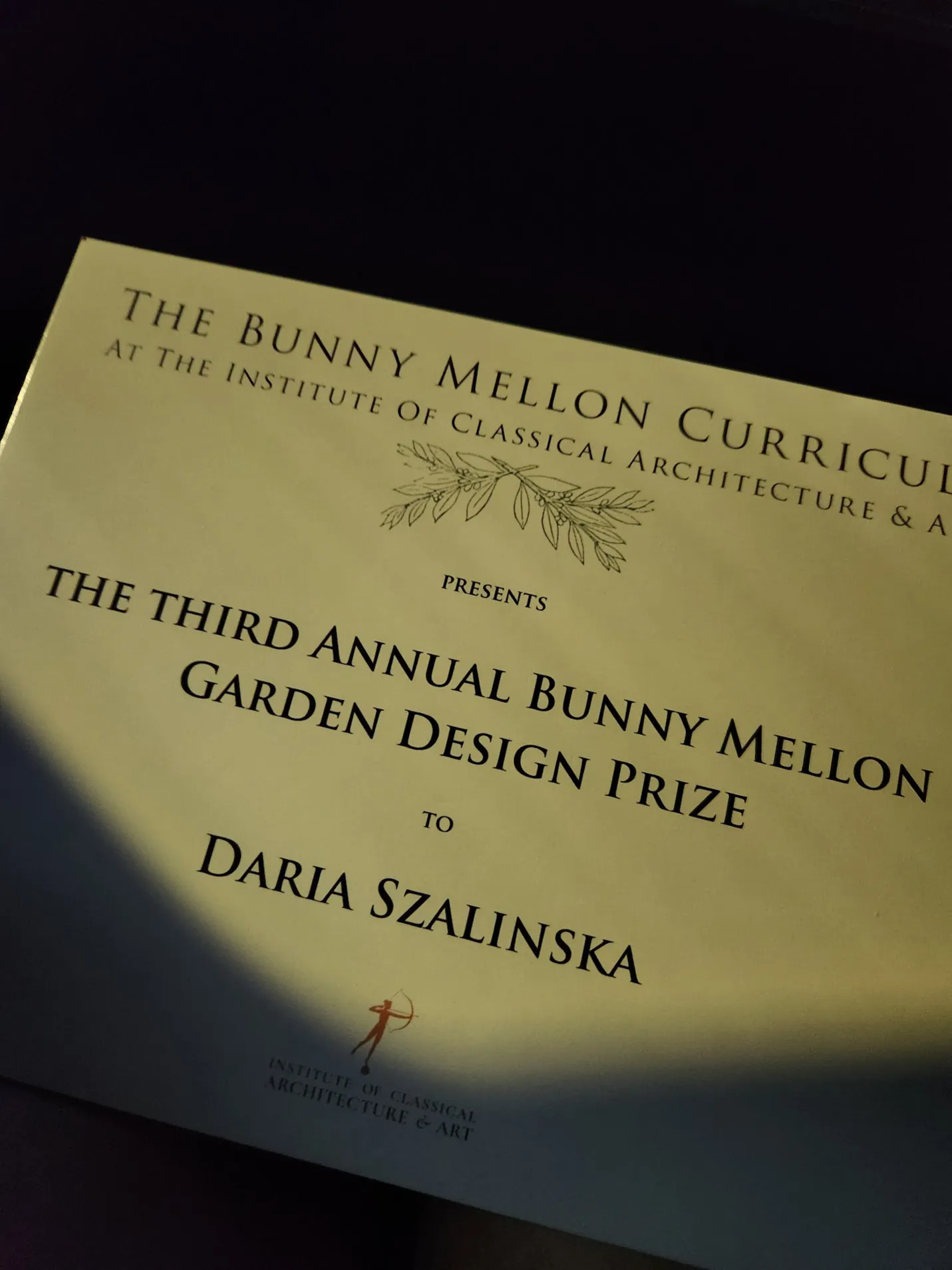
In 2024, Landelier founder Daria Szalinska was honored by the Institute of Classical Architecture & Art with the third annual Bunny Mellon Garden Design Prize, an award recognizing exceptional achievement in landscape design by emerging professionals.
The Bunny Mellon Garden Design Prize, presented by the Institute of Classical Architecture & Art (ICAA), celebrates emerging designers whose work demonstrates exceptional talent, thoughtful design, horticultural knowledge, craftsmanship, and a meaningful relationship between architecture and landscape.
Named in honor of legendary gardener and designer Rachel “Bunny” Mellon, the prize recognizes not only the success of an individual garden, but a broader approach to landscape design and the promise of an emerging professional.
For Daria, receiving the award was particularly meaningful because it recognized a way of working that had been developing over years: listening carefully to the site, working closely with materials and planting, and finding a balance between environmental responsibility, restraint, and timeless beauty.
As part of the award submission, the ICAA highlighted Meyers Pond Retreat, a Hamptons residential landscape completed while Daria was an Associate at Araiys Design Landscape Architecture.
A Garden Shaped by Its Challenges
Meyers Pond Retreat began with a series of very real site constraints.
Rather than treating those conditions as problems to conceal, the design process allowed them to become part of the garden’s identity.
The approach centered on three ideas that continue to influence Daria’s work today: respond to the site, use materials intelligently, and create something that feels as though it belongs.
Reclaimed granite planks and large stone blocks were incorporated throughout the landscape, giving new purpose to existing and salvaged materials while bringing weight, age, and permanence to the garden.
Concrete retaining walls were minimized wherever possible, allowing stone, planting, and changes in grade to resolve the landscape in a softer and more natural way.
Sustainability was never intended to read as a separate feature.
It was simply embedded in the design.
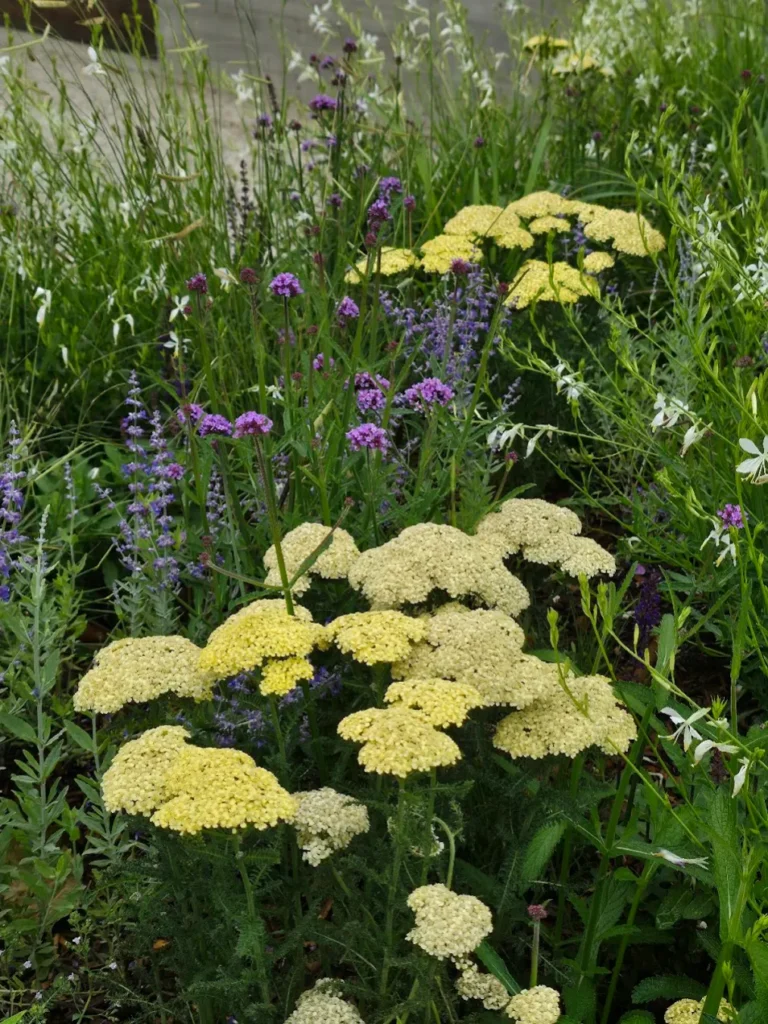
Native and site-appropriate plants became part of the broader ornamental palette, while a bioswale planted with switchgrass along the road transformed stormwater management into a landscape feature rather than an engineering afterthought.
That idea—allowing practical landscape infrastructure to also become beautiful—is something we continue to believe strongly in at Landelier.
Somewhere Between a Zen Garden and the Hamptons
The design itself evolved considerably.
What began with distinctly modern cues gradually softened into something harder to categorize: a contemporary garden with classical restraint, Japanese influence, and a distinctly Hamptons sense of ease.
The planting and material language developed into a kind of Japanese-inspired Hamptons garden, bringing together the tranquility associated with Zen gardens and the vitality of the East End landscape.
That balance became central to the project.
Strong stone geometry is softened by abundant planting. Reclaimed granite feels simultaneously ancient and modern. Carefully composed spaces sit beside looser, more naturalistic vegetation. There is structure, but the garden is never meant to feel overly controlled.
For Daria, this is where landscape design becomes most interesting: in the space between opposites.
Formal and informal.
Old and new.
Designed and seemingly accidental.
Quiet and full of life.
A garden does not necessarily need to choose one language.
The most memorable ones often speak several.
Recognition from the ICAA
The Bunny Mellon Garden Design Prize jury brought together established voices from the landscape design profession, including landscape architects and garden designers with extensive experience in residential and classical landscape design.
In discussing Daria’s work, the jury highlighted the project’s authenticity, elegance, critical thinking, and hands-on design process.
That aspect of the recognition felt especially important.
Beautiful photographs capture the finished garden, but they rarely communicate the hundreds of decisions behind it: walking a site repeatedly, adjusting a detail because something feels slightly wrong, finding a better use for a piece of stone, modifying planting in the field, or allowing the realities of construction to improve rather than dilute an idea.
Landscape design is very much a process of thinking through making.
And sometimes the best design decisions happen with muddy boots on.
Taking the Bunny Mellon Garden Design Prize to Birmingham
Receiving the prize also brought an unexpected experience: an invitation to participate in the 2024 Bunny Mellon Garden Symposium in Birmingham, Alabama, where the award was formally presented.
It was Daria’s first visit to Alabama—and a memorable introduction.
Hosted by the ICAA Southeast Chapter, the symposium, An Exploration of the Southern Landscape: Birmingham — The Natural City Beautiful, explored the city through the intertwined lenses of garden design, landscape architecture, planning, horticulture, and the City Beautiful movement.
The Bunny Mellon Garden Design Prize was presented during the opening evening reception and dinner, followed by a day of lectures, conversations, and garden visits.
And for any landscape designer, seeing gardens in person is always the best part.
The program included Railroad Park and several private residential gardens, from properties overlooking Birmingham and Shades Valley to gardens within Mountain Brook, the historic garden suburb planned in the 1920s by landscape designer Warren Manning.
The tour also included the celebrated woodland garden of Louise Wrinkle.
For someone arriving from the East End of Long Island, the landscapes felt both completely different and strangely familiar.
Different soils. Different plant communities. Different light, topography, and history.
But the fundamental questions were the same.
How does a garden belong to its place?
How much do we preserve?
How much do we intervene?
How can structure and wildness coexist?
And perhaps most importantly: how do we make landscapes that become richer and more beautiful with time?
Birmingham itself was a wonderful surprise.
The gardens were beautiful, but equally memorable were the people behind them—the designers, gardeners, horticulturists, architects, and garden lovers who gathered around a shared fascination with place, history, plants, and the endlessly imperfect art of making gardens.
Receiving the award there made the experience feel much larger than the prize itself.
From Meyers Pond Retreat to Landelier
Meyers Pond Retreat predates Landelier Landscape Atelier, but many of the ideas explored there remain deeply connected to how we approach landscape design today.
Work with what the site gives you.
Reuse before replacing.
Allow sustainability to shape the design rather than decorate it.
Use native and site-appropriate planting thoughtfully, while leaving room for horticultural character and beauty.
Respect precedent without copying it.
And never be afraid to let a project evolve.
Today, those principles continue through Landelier’s residential landscape work across Sag Harbor, East Hampton, Bridgehampton, Southampton, Amagansett, and the Hamptons, where every property brings its own ecology, architecture, history, and personality.
The Bunny Mellon Garden Design Prize was an extraordinary honor.
But perhaps its greatest meaning was the recognition of an approach to landscape design we continue to believe in very strongly:
listen carefully to the site, make thoughtful choices, and create gardens that feel inevitable once they are there.
Daria Szalinska is the founder and principal designer of Landelier Landscape Atelier, a Hamptons-based landscape design studio creating thoughtful residential gardens throughout the East End of Long Island. Before founding Landelier, Daria served as an Associate at Araiys Design Landscape Architecture, where she worked on Meyers Pond Retreat, the project highlighted as part of her 2024 ICAA Bunny Mellon Garden Design Prize recognition.